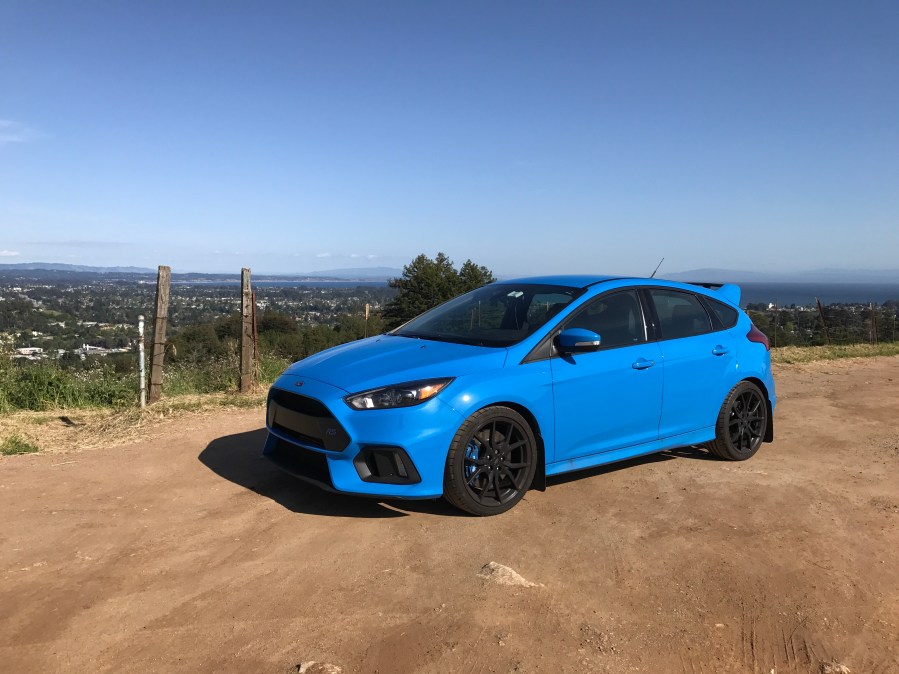
Prior to the Focus RS, I owned a Subaru BRZ. After owning the BRZ for several years, I was looking for something with more capability and more practicality. When Ford announced the third-generation Focus RS and that it would be coming to the United States, I knew that it would fit all the requirements I was looking for.
What is the Focus RS?
In order to understand what the Focus RS, we start with the special designation itself, RS, short for Rallye Sport, and Ford’s rich heritage in rally racing. For nearly 50 years, Ford has competed in rally racing with performance versions of their road cars, starting with the 15M RS in 1968, to Ford’s iconic Group B entry, the RS200, in 1984, to the Sierra RS Cosworth in 1985, and the Focus RS’s predecessor, the Escort RS Cosworth in 1992. It should also be noted that the man behind the 1970 Ford Capri RS 2600 Touring Car and head of Ford’s Motorsport Department, Jochen Neerpasch, went on to join BMW, resulting in the birth of the iconic BMW M division.
The 2016 Focus RS is the third generation of the Focus RS, the first of which launched in 2002 and the second in 2009. The third generation is the first Focus RS to not only come with all-wheel drive but also sold worldwide, including the United States.
The main competitors to the Focus RS include the Subaru WRX STi, Honda Civic Type-R (which has now also debuted in the US), Volkswagen Golf R, Mitsubishi Lancer Evolution X, Audi RS3 (the sedan version is now available in the US), and, in Europe only, the Mercedes-Benz A45 AMG, and BMW M135i.
Why I chose the Focus RS
As mentioned previously, the Focus RS fit all the requirements I was looking for:
- A very healthy amount of power: 350 hp and 350 lb ft
- All-wheel drive
- 5-door hatchback
- Manual transmission (the only available option)
- The correct proportions and right amount of aggressive aesthetics I was looking for.
- Amazing sounding exhaust note, even in low revs, as seen in Carfection’s preview.
- Maintenance costs and reliability still mostly within reason
I did look into the competition but my decision was not a difficult one:
- Subaru WRX STi – the current generation is no longer offered as a hatchback, the power unit is a bit dated, and I prefer the Focus RS’s looks and exhaust note far more than that of the STi.
- Volkswagen Golf R – while the Golf R is certainly more comfortable and refined on the inside, I have never been a fan of the exterior aesthetics of the Golf, the shape of which always reminded me of a small minivan (I may write an analysis of car design in the future).
- Up-market: BMW M2, Audi RS3 – while the BMW would have provided a more pure driving experience, and the RS3 (which would have required waiting another year) had far more power, I decided against going up-market. Those cars not only had a significantly higher purchase price, they were more complex and would cost more to maintain in the long run.
- Luxury sport sedans of similar price ranges: BMW 335i, Lexus IS350, Audi S4, and the like – simple answer: I was looking for performance and driving experience, not luxury.
I ordered my Focus RS with the following options:
- Nitrous Blue – simply love this color, though Stealth Grey was a close second choice
- RS2 package – creature comforts for long roadtrips and to keep the girlfriend happy
- Forged 19″ wheels – the forged wheels were lighter than the base wheels
- Winter wheel and tire package (18″ wheels, Michelin Pilot Alpin PA4 tires) – for taking winter trips up to Tahoe
Options I decided against:
- Michelin Pilot Sport Cup 2 Tires – the RS was still going to be more or less a daily driver, and the Pilot Super Sport tires would be sufficiently capable on track but more durable for daily driving.
- Power Moonroof – this would add additional weight to an already heavy car, and I did not anticipate using the moonroof often.
 Apex Theorem